 FocusAlpha
A 13F and a Form 4 answer different questions from different people. The 13F says which institutions held a stock at quarter-end; the Form 4 says what the company's own officers and directors did with their personal money, within two business days. The popular idea is to overlay them: when insiders and institutions accumulate the same name at the same time, you have an "insider consensus." We tested that idea on the SEC's own data for the June 2026 quarter, joining every Form 4 filed in Q2 2026 to the change in 13F holder counts for 3,985 companies. The consensus cell exists, but it is small, and the more common pattern runs the other way: where three or more insiders bought within two weeks, the company's 13F holder count rose only 52% of the time, against 73% for companies with no insider buying at all. Insiders, in this quarter as in the academic record, were buying what institutions were leaving.
TLDR:
- Q2 2026 had 49,832 Form 4s from 4,497 companies. 5,089 of the transactions were open-market purchases. After removing new registrants, purchases under $10,000 per insider, and same-day fee elections, 118 companies had a genuine cluster buy (3+ insiders within 14 days).
- Across 3,985 companies with 50+ 13F holders, the holder count rose from Q1 to Q2 for 73% of companies with no insider buying, 71% with some, and 52% with a cluster buy. Both accumulating at once: 51 companies. Cluster buying while institutions left: 43, including Nike, Boston Scientific, Zoetis and Fiserv.
- Clusters in Q1 2026 did not predict Q2 institutional inflows: 76% of those companies gained holders, versus 72% for everyone else.
- The raw Form 4 data needs repair first. One filer's 15 purchases show as $25.8 billion, 80% of all open-market buying in the quarter; the footnote reveals each "share" is 1/43,200 of an ADS and the real total is about $600,000.
13F vs Form 4: two filings, two vantage points
| Form 13F | Form 4 | |
|---|---|---|
| Who files | Institutional managers with $100M+ in 13(f) securities | Officers, directors and 10% owners of the company |
| What it reports | Long positions held at quarter-end | Each change in the insider's own holdings |
| Deadline | 45 days after quarter-end | 2 business days after the trade |
| Measured in Q2 2026 | Median filing day 44 after quarter-end, per dollar reported (our 13F deadline analysis) | 95.5% of Form 4s filed within 2 business days; 2.2% took more than 5 |
| Volume, Q2 2026 | 8,857 holdings reports | 49,832 Form 4s, 4,497 issuers |
Sources: SEC Form 13F FAQ; SEC Form 4 general instructions; FocusAlpha analysis of the SEC Form 13F and Form 3/4/5 data sets. Form 4 timeliness measured on the 26,779 Form 4s reporting trades dated April 1 to May 31, 2026, in business days excluding Memorial Day and Juneteenth.
The two are genuinely independent signals. Institutions buy from the outside, on models and meetings; insiders act from the inside. The academic evidence for each is real. Chen, Hong and Stein showed that the change in breadth, the number of holders, predicts returns: stocks in the bottom decile of breadth change underperformed the top decile by 6.38% over the following twelve months in their 1979 to 1998 sample (Chen, Hong & Stein, 2002). Alldredge and Blank found that insiders cluster trades with colleagues, and that clustered purchases are followed by abnormal returns above 2% in the next month (Alldredge & Blank, 2019). What neither paper says is that the two signals arrive together. Lakonishok and Lee documented the opposite tendency: insiders are contrarian, buying after prices fall (Lakonishok & Lee, 2001). So before building a consensus screen, we wanted to know how often the two disclosures actually agree.
The Q2 2026 Form 4 data, before and after cleaning
We started from the SEC's Insider Transactions data set for Q2 2026, which flattens every Form 3, 4 and 5 filed between April 1 and June 30 into tables. Open-market purchases are transaction code P. The raw count is easy; the usable count takes work.
| Q2 2026 Form 4 open-market purchases | Companies | Note |
|---|---|---|
| Any purchase, code P, priced | 1,138 | 5,089 transactions |
| In companies with a Section 16 filing before April 2026 | 1,045 | Drops 93 IPOs and new registrants, whose "purchases" are offering allocations |
| 3+ distinct insiders bought during the quarter | 205 | |
| 3+ distinct insiders bought within any 14-day window | 173 | |
| ...each buying at least $10,000, excluding same-day, same-price groups | 118 | 19 groups dropped as fee elections or plan purchases |
Source: FocusAlpha analysis of the SEC Form 3/4/5 data set, Q2 2026. Form 4 only; amendments (4/A) excluded.
Three defects in the raw rows are worth naming, because each one would corrupt any screen built on top:
- Dollar values that aren't. Multiplying shares by price across all 5,089 purchases gives $32.4 billion. $25.8 billion of that, 80%, comes from 15 purchases by one director-by-deputization of SaverOne, an Israeli ADS issuer. The filing's own footnote explains: the price is per ADS, the shares are ordinary shares, and each ADS represents 43,200 of them. The real total is about $600,000. On the sale side, a Scorpio Tankers Form 4 reports 15,000 shares at $1,230,435 "per share"; the footnote says that figure is the total. As filed, that one row is an $18.5 billion sale.
- Purchases that aren't conviction. Ten Simon Property Group directors each "bought" between 36 and 491 shares on March 31 at exactly $183.80. That is stock taken in lieu of director fees, coded P. On June 5, 31 Taiwan Semiconductor officers filed purchases of 7 to 150 ADS each at $76.01, the shape of an employee purchase plan. A cluster screen that counts heads will flag both.
- New registrants. The largest single "open-market" purchase by a seasoned-looking buyer was RA Capital's $395 million in Parabilis Medicines on June 11, the company's first week as a reporting issuer. Ninety-three companies had no Section 16 filing before April; together they carried $2.0 billion of purchase value.
The SEC says this plainly in the data set's readme: the tables are as filed and not a substitute for the filings. Our figures below use the cleaned 118.
Joining insider clusters to 13F holder counts
For the institutional side we used the same method as our 13F deadline post: every original 13F-HR for the quarters ended March 31 and June 30, 2026, restricted to the 8,609 managers that filed both, with a holder defined as a manager reporting a long share position. The 13F data set carries CUSIPs, not tickers, so we mapped CUSIPs to symbols with the SEC's fails-to-deliver files for June and July 2026 and symbols to filer CIKs with the SEC's company tickers file. That left 3,985 companies with at least 50 holders in Q1 and a Form 4 filer identity; a name check between the 13F issuer name and the SEC registrant name agreed for 97.8% of them.
| Q2 2026 insider buying | Companies | Holder count rose Q1 to Q2 | Median net new holders |
|---|---|---|---|
| No open-market purchase | 3,317 | 73.2% | +10 |
| Some purchases, no cluster | 570 | 71.4% | +8 |
| Cluster buy (3+ insiders in 14 days) | 98 | 52.0% | +2 |
Source: FocusAlpha analysis of SEC Form 13F and Form 3/4/5 data sets. The 21-point gap between the cluster group and the rest has a 95% confidence interval of ±10 points (chi-square 20.9).
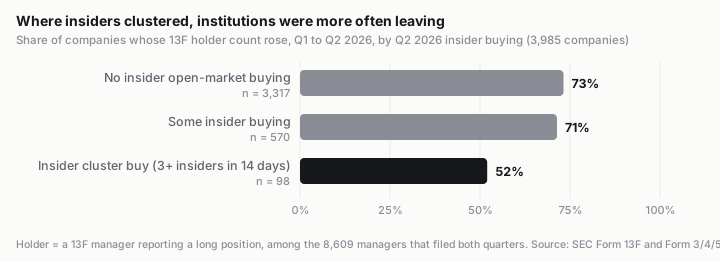
Figure 1: Share of companies whose 13F holder count rose from Q1 to Q2 2026, by insider buying in Q2 2026. Source: FocusAlpha analysis of the SEC Form 13F and Form 3/4/5 data sets.
The base rate matters here. Among the same 8,609 managers, most stocks gained holders this quarter, so 73% is the "nothing happened" reading. Companies where insiders clustered their buying were the exception, landing near a coin flip.
The consensus cell is small, and the other cell is nearly as large
| Q2 2026, 98 cluster-buy companies | Count | Examples (13F holders Q1 to Q2, insiders buying) |
|---|---|---|
| Holder count rose ("insider consensus") | 51 | Burke & Herbert 158 to 206, 3 insiders; Millrose Properties 469 to 515, 4; Valvoline 408 to 442, 3; WesBanco 309 to 338, 4; Liberty Latin America 196 to 218, 5 |
| Holder count fell | 43 | Nike 1,854 to 1,681, 4 insiders; Boston Scientific 1,626 to 1,437, 3; Zoetis 1,569 to 1,396, 3; Fiserv 1,222 to 1,113, 6; S&P Global 2,052 to 1,956, 3; GE HealthCare 1,231 to 1,188, 8 |
| Unchanged | 4 |
Source: FocusAlpha analysis of SEC Form 13F and Form 3/4/5 data sets, Q2 2026.
Nike is the clean illustration. Between April 7 and April 13, 2026, four Nike insiders bought on the open market at $42 to $43: CEO Elliott Hill, and directors Tim Cook, John Rogers Jr. and Robert Swan (Form 4, April 10). Over the same quarter, 173 fewer 13F managers reported a Nike position. That is not a contradiction; it is the pattern Lakonishok and Lee described. Insiders buy on weakness, and weakness is when institutions leave. The consensus cell, both sides accumulating, held 51 companies out of 3,985, and skewed to small and mid caps: the median cluster company had 209 holders, against 218 for the universe.
Did Q1 clusters predict Q2 institutional inflows?
If insiders lead and institutions follow, a cluster in one quarter should show up as new holders in the next. We ran the same screen on the Q1 2026 data set (Form 4s filed January to March, restricted to companies with Section 16 filings in the second half of 2025) and checked the Q1-to-Q2 change in holders.
| Q1 2026 insider buying | Companies | Holder count rose Q1 to Q2 | Median net new holders |
|---|---|---|---|
| Cluster buy in Q1 | 82 | 75.6% | +9 |
| Everyone else | 3,903 | 72.4% | +10 |
Source: FocusAlpha analysis of SEC Form 13F and Form 3/4/5 data sets.
Three points is inside the noise for 82 companies. One quarter of lead time is not enough for a cluster to show up as institutional breadth, at least not in this quarter. This is consistent with the return evidence being about prices, which move daily, rather than holder counts, which move quarterly.
Insiders buy where institutions are scarce
The two signals also live in different parts of the market. Sort the 3,985 companies into quintiles by 13F holder count and the pattern is monotonic.
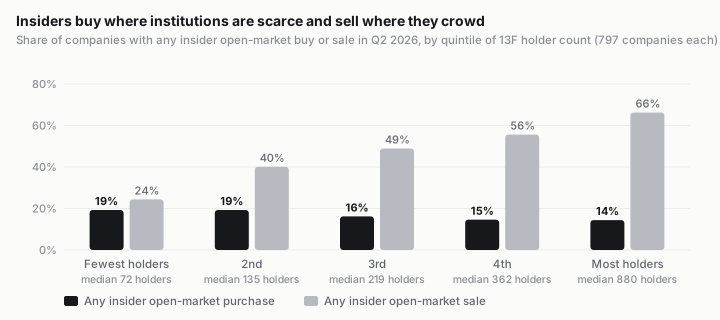
Figure 2: Share of companies with any insider open-market purchase or sale in Q2 2026, by quintile of 13F holder count (797 companies per quintile). Source: FocusAlpha analysis of the SEC Form 13F and Form 3/4/5 data sets.
Among the 100 most widely held companies, 13 had any insider open-market purchase in Q2 2026 and 74 had insider sales. In the top 25, from Microsoft (6,020 holders) down to McDonald's, insiders bought at only two, Broadcom and Caterpillar, one insider each. Insider buying concentrates in the least-held quintile, where the median company has 72 holders. That is where a consensus read, when it appears, has room to matter, and it is also where 13F coverage is thinnest.
How to read the two together
- Treat cluster buying as a contrarian flag, not a confirmation. In Q2 2026 it coincided with falling breadth almost as often as rising. The useful question is why institutions were leaving, and the 10-Q and earnings call answer that better than a holder count.
- Date every signal. A Form 4 is two days old; the 13F that describes the same quarter arrives up to 45 days after it ends, and most of the value arrives on the last three days. A consensus view built in early May is comparing April insider trades with December holdings.
- Clean before you count. Drop new registrants, apply a dollar floor per insider, and drop same-day, same-price groups. Read footnotes for ADS ratios and total-versus-per-share prices. Of 205 companies with three buyers in the quarter, 87 fell out of the cluster set on these rules alone.
- Keep the citation. Every number above traces to an accession number. A screen that reports "four insiders bought" without the four filings behind it cannot be audited, and a Nike-sized reversal deserves auditing.
This is a description of two public disclosures, not investment advice.
Methodology
- Form 4 data: SEC Insider Transactions data sets for 2025 Q3 through 2026 Q2, filed as of the quarterly cut. Form 4 only (49,832 in Q2 2026); 4/A amendments excluded. Open-market purchase = non-derivative transaction, code P, acquired, with positive shares and price. Sale = code S, disposed.
- Seasoned issuer: issuer CIK with at least one Form 3, 4 or 5 in the three data sets before the quarter being screened.
- Cluster buy: at least three distinct reporting-owner CIKs with purchases in the same issuer within a 14-calendar-day window, each totalling at least $10,000 within the window, excluding windows in which all qualifying purchases share one date and one price.
- 13F holder counts: original 13F-HR filings for periods ended March 31 and June 30, 2026, from the SEC Form 13F data sets (filings March to August 2026), restricted to the 8,609 managers that filed both quarters; a holder is a manager reporting a positive share count with no put or call flag. Net new holders = managers newly reporting the CUSIP minus managers that dropped it.
- Join: CUSIP to symbol via SEC fails-to-deliver files (June and July 2026), symbol to CIK via
company_tickers.json; one row per company, keeping the most widely held CUSIP. Universe: 3,985 companies with 50+ holders in Q1. - Timeliness: business days from transaction date to filing date for Form 4s reporting trades dated April 1 to May 31, 2026, so that late filings within the quarter are captured; filings made after June 30 are not in the Q2 data set.
- Dollar figures are shares times reported price and inherit the as-filed defects described above; they are quoted only where the text says so.
FAQ
What is the difference between a 13F and a Form 4?
A 13F is a quarterly snapshot of an institutional manager's long positions, due 45 days after quarter-end. A Form 4 is an insider's report of a change in their own holdings, due within two business days of the trade. In Q2 2026, 95.5% of Form 4s met the two-day deadline, while the median 13F dollar arrived 44 days after quarter-end.
Do insider cluster buys and institutional buying happen together?
Not usually. In Q2 2026, 98 companies with 50+ 13F holders had an insider cluster buy; the 13F holder count rose for 51 of them and fell for 43. Companies with no insider buying gained holders 73% of the time, so cluster buying coincided with institutional selling more often than average.
Does insider cluster buying predict institutional inflows the next quarter?
Not in this sample. Companies with a cluster buy in Q1 2026 gained 13F holders in Q2 75.6% of the time, versus 72.4% for all other companies, a difference within noise for 82 companies.
Why do Form 4 dollar values look wrong?
Because the data is as filed. A SaverOne director's 15 purchases compute to $25.8 billion, 80% of all Q2 2026 open-market buying, until the footnote explains each ADS is 43,200 ordinary shares and the real total is about $600,000. A Scorpio Tankers sale reports the total proceeds in the price-per-share field. Read footnotes before summing.
How do you combine 13F and Form 4 data?
Map both to one company identifier (13F data carries CUSIPs, Form 4 carries the issuer CIK), define a holder and a cluster explicitly, align each signal to its own date, and clean the Form 4 side: drop new registrants, set a dollar floor per insider, and exclude same-day, same-price fee elections. FocusAlpha's insider trades and institutional holders by ticker endpoints return both series by ticker with each row tied to its filing.
What is FocusAlpha?
FocusAlpha is a SEC filings API and agent-ready financial data layer: it turns SEC filings (10-K, 10-Q, 8-K, 13F, Form 4), earnings-call transcripts, and other trusted company communications into structured, normalized data where every value keeps its citation back to the source document. AI agents connect via API or MCP to research public companies from complete, trusted information.