 FocusAlpha
The 13F filing deadline for the June 2026 quarter was Friday, August 14. We took the SEC's own Form 13F data set for every filing made between June 1 and August 31, 2026, and measured when each holdings report actually arrived and what shape it arrived in. Most filers were in well before the deadline. Most of the money was not: 65.8% of all reported 13F value landed in the final three days, and 27.6% on deadline day itself. Q2 2025 had exactly the same 65.8%. The data also needs repair before anyone, human or agent, should read it: hundreds of filings still report in the wrong units, one CUSIP can carry 165 different company names, and a naive quarter-over-quarter comparison says 2,575 managers dumped Honeywell in Q2. They didn't.
TLDR:
- 8,857 managers filed Q2 2026 13F holdings reports. By August 11, 65% of them had filed, but only 33% of the reported value. The 500 largest filers hold 90% of the value, and 61% of them filed in the last three days.
- The deadline-day snapshot isn't final. Of the Q2 2025 filers we followed for a year, 4.7% filed after the deadline, and 182 managers later restated their report, a third of them more than 90 days later.
- Raw 13F data has four repeatable defects: values in thousands instead of dollars (334 filings), issuer names that don't match (a median 18 spellings per widely held stock), CUSIPs that break on corporate actions, and invalid identifiers. Clean these before you compare quarters.
The 13F filing deadline, and when managers actually file
A 13F is due within 45 days after the end of each calendar quarter, which puts the deadlines around February 14, May 15, August 14 and November 14. When the 45th day falls on a weekend or holiday, the SEC says the filing is due on the first business day after. For the quarter ended June 30, 2026, that was Friday, August 14.
The rule sets the latest date, not the typical one, so we measured the typical one. Counting filers, the answer looks relaxed: the median manager filed 37 days after quarter-end, and 39% were in within 30 days. Weighting by the dollars each filing reports changes the picture completely.
| Q2 13F holdings reports | Q2 2026 | Q2 2025 |
|---|---|---|
| Managers filing a 13F-HR | 8,857 | 8,039 |
| Median filing day after quarter-end, per filer | 37 | 38 |
| Median filing day after quarter-end, per dollar | 44 | 44 |
| Filed within 30 days: share of filers / of value | 39% / 6% | 37% / 7% |
| Filed in the last 3 days: share of filers / of value | 33% / 66% | 37% / 66% |
| Filed on deadline day: share of filers / of value | 20% / 28% | 22% / 33% |
| Filed late, by Aug 31: share of filers / of value | 1.8% / 0.8% | 2.6% / 3.8% |
Source: FocusAlpha analysis of the SEC Form 13F data sets for filings made June 1 to August 31 of each year; original 13F-HR per manager, value from each filing's summary page. Methodology below.
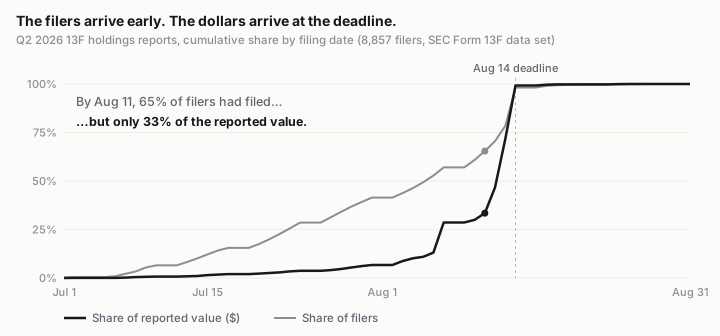
Figure 1: Cumulative share of Q2 2026 13F filers and of reported value, by filing date. Source: FocusAlpha analysis of the SEC Form 13F data set, June 1 to August 31, 2026.
The split is about size. The smaller half of filers, by reported value, filed at a median of 35 days. Of the 100 largest, 71 filed in the final three days and 31 on deadline day. Widen that to the 500 largest managers, who together report 90% of all 13F value, and 61% of them filed in the last three days and 34% on the deadline itself. Berkshire Hathaway filed on August 14 in both 2025 and 2026.
For anyone reading institutional positioning, the practical number is the per-dollar median of 44 days. The typical dollar of 13F data describes a portfolio as it stood six weeks earlier. The within-quarter lag adds to that: a position opened in early April is first visible in mid-August, more than four months after the trade.
The quarter you download on deadline day isn't final
A 13F snapshot pulled on August 15 is missing filings, and some of the filings it has will change. To measure how much, we followed the Q2 2025 quarter through a full year of later SEC data sets, to August 2026.
| Q2 2025 filings, followed for 12 months | Count |
|---|---|
| Managers who eventually filed a 13F-HR | 8,218 |
| Filed after the August 14 deadline | 385 (4.7%) |
| Filed after August 31, 2025 | 179 |
| Latest original filing for the quarter | August 27, 2026 |
| Amendments filed (13F-HR/A) | 260, from 227 managers |
| Managers who filed a restatement | 182 (2.2%) |
| Restatements filed more than 90 days after the original | 33% |
Source: FocusAlpha analysis of five consecutive SEC Form 13F data sets, June 2025 to August 2026.
The SEC's own FAQ defines the two amendment types: a restatement "must resubmit your entire filing, as corrected", while a new-holdings amendment adds securities that were left out, for example when confidential treatment expires. The median restatement came 16 days after the original, and the latest came 377 days after. Back-filing is real too. In the June to August 2026 window alone there were 471 submissions for quarters more than a year old, from 47 managers, going back as far as September 2001.
None of this is exotic, but it has a clear consequence. A holding is only meaningful with two dates attached: the quarter it describes, and the filing it came from. If the source can be amended, you also need the accession number, so you can tell which version of the filing you read.
Four defects in the raw 13F data
The SEC is explicit that an EDGAR acceptance message "does not address the substantive accuracy or correctness of the filing". We checked all 3.4 million position rows in the Q2 2026 holdings reports for the problems that break analysis most often.
1. Values in the wrong units. Since January 3, 2023, 13F market values must be reported rounded to the nearest dollar; before that, they were in thousands. More than three years later, 334 Q2 2026 holdings reports (3.8%) still look like thousands: at least 80% of their priced rows imply a share price about 1/1000 of what every other filer reports for the same security. That is down from 438 (5.4%) a year earlier. The error runs the other way too. One filing reported 122 positions at exactly 1,000 times the consensus price, overstating its book by roughly $134 billion. Any screen that sums or ranks 13F dollars without a price check inherits both errors.
2. One security, dozens of names. A 13F identifies a holding by CUSIP, but it also carries a free-text issuer name, and that is the field people join on. Across Q2 2026 filings, NVIDIA's single CUSIP appears under 62 distinct names, from "NVIDIA CORPORATION" and "NVIDIA CORP" to "Nvidia Corp" and "NVIDIA Corporation - Common Stock". Alphabet Class A has 165. Among the 4,627 securities held by at least 100 filers, the median is 18 spellings each. The optional FIGI identifier that could settle this is filled in on only 12.3% of rows.
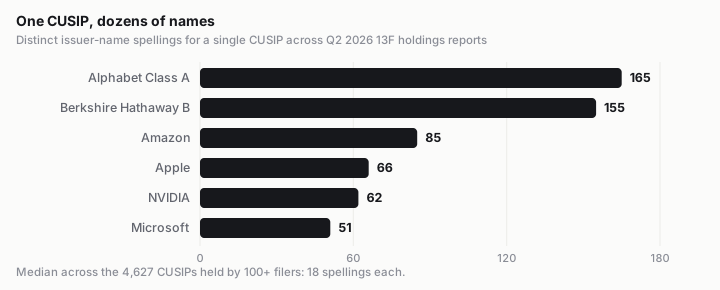
Figure 2: Distinct issuer-name spellings for a single CUSIP. Source: FocusAlpha analysis of the Q2 2026 SEC Form 13F data set.
3. Identifiers that break on corporate actions. This is the defect that produces confident wrong answers. Compare the 8,609 managers who filed both Q1 and Q2 2026 by CUSIP, and the biggest "exits" of the quarter look dramatic.
| Company | What happened | Naive holder count, Q1 → Q2 | Q2 filers still using the old CUSIP |
|---|---|---|---|
| Honeywell | 1-for-2 reverse split and Honeywell Aerospace spin-off, effective June 29, 2026 | 2,723 → 148 | 133 of 2,162 (6.2%) |
| DuPont | 1-for-3 reverse split, effective June 24, 2026 | 1,196 → 58 | 54 of 1,122 (4.8%) |
| Carnival | Dual-listed structure unified as Carnival Corporation Ltd., May 7, 2026 | 996 → 48 | 48 of 1,034 (4.6%) |
Source: FocusAlpha analysis of the SEC Form 13F data sets for Q1 and Q2 2026; corporate actions per each company's announcement.
Nobody sold. Each company got a new CUSIP, and most filers moved to it: 2,007 managers reported Honeywell under its new CUSIP. But a minority kept the old one, and the split changes share counts as well as identifiers. Of the 60 Q2 filings that still used DuPont's old CUSIP, 12 also reported the pre-split share count. A reverse split one day before quarter-end, as Honeywell's was, gives filers almost no time to update their records.
4. Identifiers that aren't valid at all. Smaller, but it adds up. 3,169 non-option rows (0.09%) in 229 filings carry a CUSIP that fails its own check digit, and 205 filings use lowercase letters in CUSIPs, which breaks exact-match joins.
What the corrected Q2 2026 data does show
Once identifier breaks are set aside, the quarter's biggest change in institutional ownership is easy to read. Among the 8,609 managers who filed both quarters, these stocks gained the most new holders (stocks with at least 300 holders in Q1):
| Stock | Holders, Q1 2026 | Holders, Q2 2026 | Net new holders |
|---|---|---|---|
| Intel | 2,496 | 3,448 | +952 |
| Micron Technology | 2,931 | 3,771 | +840 |
| Advanced Micro Devices | 3,080 | 3,855 | +775 |
| Marvell Technology | 1,499 | 2,147 | +648 |
| SanDisk | 1,150 | 1,781 | +631 |
| Applied Materials | 2,862 | 3,402 | +540 |
| Seagate Technology | 1,419 | 1,906 | +487 |
| Dell Technologies | 1,598 | 2,082 | +484 |
Source: FocusAlpha analysis of the SEC Form 13F data sets. Holder = a manager reporting a long share position (options excluded).
Eight of the top eight are semiconductors, memory, storage or AI hardware. Treat it as breadth, not conviction: a holder count doesn't show position size, and "new holders" include index and quant managers adding names mechanically. The other end of the table needs the same care. The three largest apparent exits are the identifier changes above, and most of the rest drop to single-digit holder counts. That is the pattern of a completed acquisition, not a sell-off, and it should be checked before it is read as a signal.
How an agent should read 13F data
The defects above are why "just give the model the 13F" fails. An agent can't see that a value is in thousands, that two names are one company, or that a CUSIP changed a day before quarter-end. The fixes are mechanical, and they belong in the data layer, not in a prompt:
- Carry two dates on every position: the report period, and the filing date. The gap between them is the staleness of that row.
- Keep the accession number, so every number can be traced to the exact filing, and amendments can be detected.
- Resolve CUSIPs to tickers instead of joining on issuer names, and check identifier changes around splits, spin-offs and redomiciles before comparing quarters.
- Sanity-check the implied price (value ÷ shares) against the market before summing dollars.
- Remember the limits of the form itself: long-only, US-listed securities, one day per quarter. Faster disclosures such as Form 4 insider trades arrive in two business days and can confirm or contradict a stale snapshot.
This is how FocusAlpha serves 13F data to agents. The institutional holdings API returns one row per position with the ticker resolved from the CUSIP, a reported_price computed as value ÷ shares so a units error is visible at a glance, and the report_period, filing_date and accession_number of the filing behind it. Here is a real row from Berkshire Hathaway's Q2 2026 filing, as returned by the holdings-by-investor endpoint (some fields trimmed):
{
  "ticker": "GOOGL",
  "cusip": "02079K305",
  "name_of_issuer": "ALPHABET INC",
  "shares": 78791167,
  "value_usd": 28157599351,
  "reported_price": 357.37,
  "report_period": "2026-06-30",
  "filing_date": "2026-08-14",
  "accession_number": "0001193125-26-352200"
}
The coverage is scoped, and we state it plainly: holdings come from roughly the 500 largest US managers by AUM, for up to the last eight quarters. That is not all 8,857 filers. By our count, though, the 500 largest filers report about 90% of all 13F value. The same data is available to Claude through the FocusAlpha MCP server, next to Form 4 trades and SEC filings, and our institutional holdings and Form ADV data covers the managers themselves. The broader case for putting a cited layer between agents and raw filings is in why AI agents need a trusted data layer.
Methodology
- Data: SEC Form 13F data sets for filings made June 1 to August 31, 2026 and 2025, plus the three sets in between (September 2025 to May 2026) for late filings, amendments and Q1 2026 holdings. The Q2 2026 set is dated September 14, 2026 and ends at August 31, so later Q2 2026 filings are not included.
- Filers: the first original 13F-HR per filer CIK for the quarter. 13F notice filings (13F-NT), which report no holdings, are excluded; there were 1,936 for Q2 2026.
- Value: the table value total on each filing's summary page, as reported, before any correction. Totals double-count where one manager's holdings are also reported inside another's combination report.
- Units test: implied price (value ÷ shares) on share rows without options, compared with the median across filers for the same CUSIP (securities with at least five priced rows). A filing counts as "in thousands" when at least 80% of its priced rows sit between 1/2,000 and 1/500 of that median.
- Holders: managers reporting more than zero shares of a CUSIP in share rows, options excluded, among the 8,609 managers who filed both Q1 and Q2 2026.
FAQ
When is the 13F filing deadline?
Form 13F is due within 45 days after the end of each calendar quarter: around February 14, May 15, August 14 and November 14. If the 45th day falls on a Saturday, Sunday or holiday, the SEC says the filing is due on the first business day after. The Q2 2026 deadline was Friday, August 14, 2026.
When do most managers actually file their 13F?
Most managers file well before the deadline, but most of the money doesn't. For Q2 2026 the median manager filed 37 days after quarter-end, yet 65.8% of all reported 13F value arrived in the final three days and 27.6% on deadline day. Among the 500 largest filers, 61% filed in the last three days. Q2 2025 showed the same 65.8%.
Are 13F filings amended after the deadline?
Yes. Following the Q2 2025 quarter for a year, we found 260 amendments from 227 managers, and 182 managers filed a full restatement. A third of the restatements came more than 90 days after the original filing. Another 4.7% of managers filed their original report after the deadline, the latest a full year late.
Why do some 13F values look off by a factor of 1,000?
Since January 3, 2023, 13F values must be reported in whole dollars; before that, they were reported in thousands. In Q2 2026, 334 holdings reports (3.8%) still appeared to use thousands, so their positions look about 1,000 times too small. At least one filing made the opposite error. Checking each row's implied price (value ÷ shares) against the market price catches both.
How can I get 13F data into Claude?
Connect Claude to the FocusAlpha MCP server and ask in plain language, for example who the largest institutional holders of a ticker are and when each of their 13Fs was filed. Each row comes back with the ticker, report period, filing date and accession number, so every answer cites the filing it came from. Coverage is roughly the 500 largest US managers, up to the last eight quarters.
What is FocusAlpha?
FocusAlpha is a SEC filings API and agent-ready financial data layer: it turns SEC filings (10-K, 10-Q, 8-K, 13F), earnings-call transcripts, and other trusted company communications into structured, normalized data where every value keeps its citation back to the source document. AI agents connect via API or MCP to research public companies from complete, trusted information.