FEATURED · DATA INFRASTRUCTURE
Why AI Agents Need a Trusted Data Layer
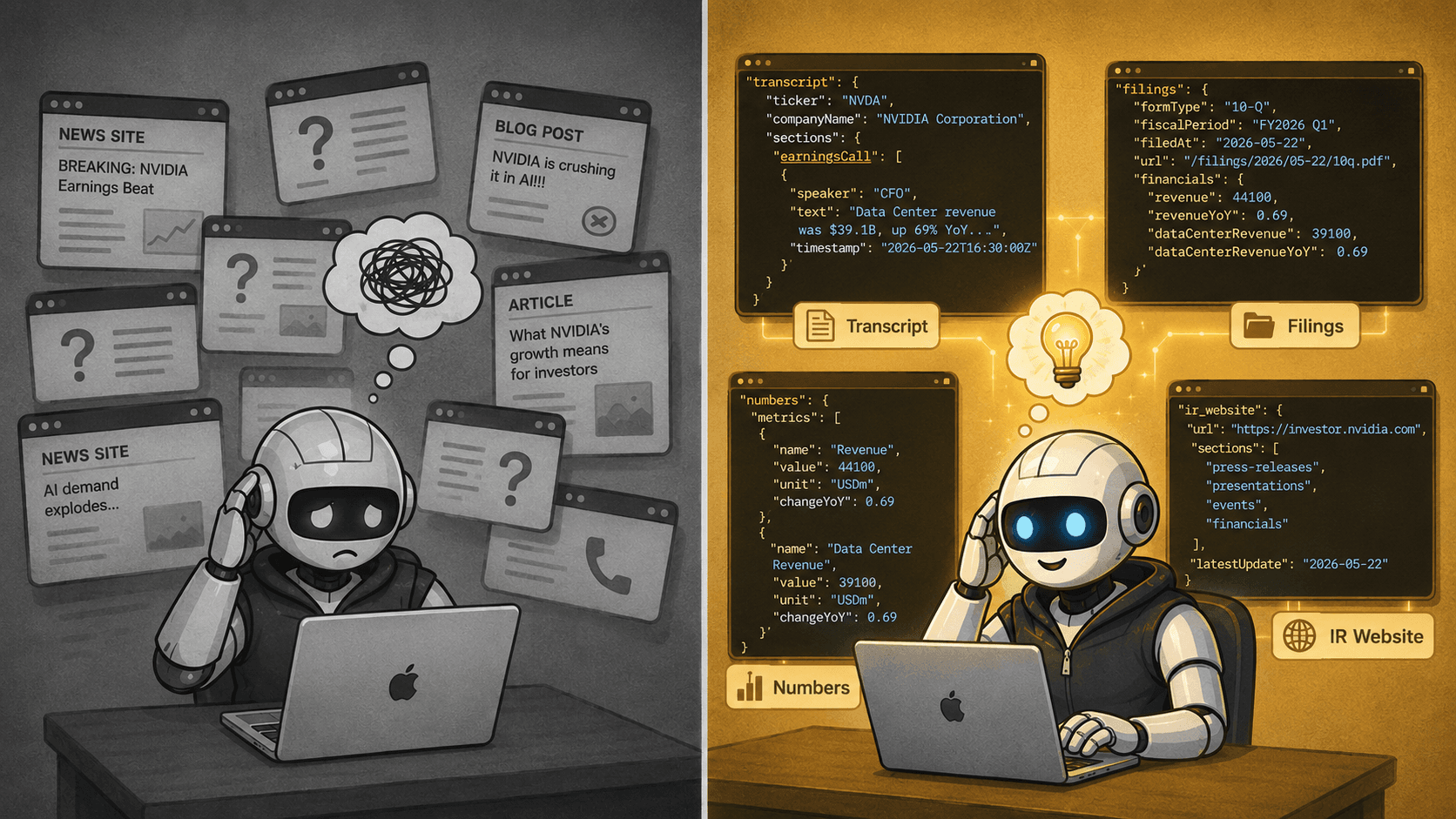
Half of new web articles are now AI-written and their citations often don't hold up. A trusted data layer gives agents structured, cited SEC filings to read before the noise.

FEATURED · DATA INFRASTRUCTURE
Half of new web articles are now AI-written and their citations often don't hold up. A trusted data layer gives agents structured, cited SEC filings to read before the noise.

13F holdings and insider trades come over a REST API; earnings-call retrieval comes over MCP. Here's how to wire each into a Claude workflow, with real config.

Two 2026 benchmarks show the same pattern: frontier models that rarely hallucinate on general text get measurably worse on multi-step financial calculations.

Berkshire's first 13F under Greg Abel and Li Lu's Himalaya both leaned into Alphabet in Q1 2026 — here's what the filings show, and why the snapshot is stale.

Coverage claims, silent substitutions, and taxonomy drift break financial agents quietly. Here's what to actually test before trusting a data vendor in production.

Five vendors — financialdatasets.ai, FMP, Massive, EODHD, and FocusAlpha — call themselves financial data APIs, but cover, price, and target different things.

13F shows what institutions own; Form 4 shows what insiders buy. Overlay the two for a consensus signal — and learn the crowding trap that breaks it.

A 13F shows only long, US-listed equity as of quarter-end. The four structural blind spots in institutional holdings data — and how not to over-read them.

13F Pro runs 10 AI analysts that debate 6,000+ stocks daily, every claim tied to an SEC filing. A look at its design and the build-or-buy question beneath it.

A viral investor thread said the model (the Brain) barely matters — the Hand (data, tools, context) differentiates financial agents. 2026 benchmarks agree.

13F institutional holdings data reaches the public 45 to 135 days late. Here's how an AI agent layers Form 4 trades and 8-Ks to close the timeliness gap.

A new study ran LLM-compressed 10-Qs and earnings calls through an investment-decision task. Summaries flipped the decision in up to half of cases — without saying anything false.

The most common question we get: won't better models make the data layer unnecessary? The benchmark evidence points the other way — the ceiling on answer quality is set by the data.

What a SEC filings API needs before AI agents can rely on it: EDGAR's real constraints, the failure data on retrieval pipelines, and a seven-point checklist.

EDGAR is free and its JSON APIs are real — so when does a SEC filings API earn its keep? An honest cost breakdown for teams wiring AI agents to SEC filings.

8-Ks are how public companies announce material events. Monitoring them with an agent fleet sounds simple — until EDGAR's rate cap, amendments, and event classification get in the way.

Keyword search finds a word; agents need to find a theme across dozens of earnings calls. What an earnings call transcripts API needs to make cross-company theme retrieval work.

A study ran LLM summaries of earnings-call transcripts through an investment-decision task. The summaries flipped the call in up to half of cases — usually by cutting one management qualifier.