 FocusAlpha
Open the full model: Anthropic (ANT) three-statement model, built by FocusAlpha Model Builder. Every reported number links to the exact place it is printed in the S-1.
Anthropic's IPO filing, the S-1 filed October 26, 2026, shows a company that sells intelligence by the token and has just become profitable on an operating basis. We built a full Anthropic financial model from the S-1 with FocusAlpha Model Builder: income statement, balance sheet, cash flow, revenue drivers and a commitments schedule. The model reaches $195bn of revenue in 2028, in line with the $190–200bn projection Reuters reported in August. The problem is that $200bn is about what Anthropic needs just to pay for the compute it has already signed for.
TLDR:
- Anthropic's revenue grew 1,368% year on year in Q2 2026 while compute and infrastructure cost grew 300%. Compute fell from 251% of revenue to 48%, and the operating margin turned positive at 8.4%.
- The S-1 lists $265.6bn of fixed compute commitments at June 30, 2026, plus $245bn signed since. On a straight-line basis the named contracts cost about $115bn a year by 2028.
- At today's cost structure, Anthropic breaks even on that compute at about $203bn of revenue. So the reported $190–200bn 2028 target only just covers the infrastructure.
How does Anthropic make money from Claude? 80% is pay-per-token
In the first half of 2026 Anthropic made $16.3bn of revenue. Most of it is usage-based: Claude API calls and Claude Code, billed by the token. Subscriptions (Pro, Max, Team and Enterprise seats) are the other fifth.
| Anthropic revenue breakdown, H1 2026 | USD m | Share |
|---|---|---|
| Consumption-based | 13,064 | 80% |
| Subscription-based | 3,222 | 20% |
| United States | 11,763 | 72% |
| International | 4,523 | 28% |
| Customers with $100k+ revenue (TTM) | 12,000 | 74% |
| Sold through cloud marketplaces (CSP) | — | 48% |
| Total revenue | 16,286 | 100% |
Source: Anthropic S-1, filed 2026-10-26, as compiled in the FocusAlpha Anthropic model.
Two points stand out. First, growth is driven by large enterprise accounts. Customers paying $100k or more a year went from about 20 at the end of 2023 to more than 11,900 at September 30, 2026, and 1,900 of them now pay more than $1mn. Net revenue retention is about 900%, a figure that reflects an early adoption burst and cannot be extrapolated. Second, the cloud providers control a large part of distribution. Sales through Amazon, Google and Microsoft marketplaces rose from 11% of revenue in 2023 to 48% in the first half of 2026.
How fast is Anthropic's revenue growing? Our 2026–2028 forecast
Model Builder forecasts revenue from the drivers the S-1 actually prints, not from a single growth rate. Anthropic gives the number of $100k+ customers and the revenue they generate, so revenue = $100k+ customers × revenue per customer + revenue from everyone else.
| Anthropic revenue forecast (USD m) | 2025 | 2026E | 2027E | 2028E |
|---|---|---|---|---|
| Customers with $100k+ revenue (TTM), year end | 1,500 | 11,900 | 21,685 | 23,800 |
| Growth | +650% | +693% | +82% | +10% |
| Revenue per $100k+ customer (USD m) | 4.1 | 6.4 | 6.4 | 6.4 |
| Revenue from $100k+ customers | 3,500 | 42,880 | 107,473 | 145,552 |
| Revenue from other customers | 1,085 | 15,871 | 41,524 | 49,484 |
| Total revenue | 4,585 | 58,751 | 148,997 | 195,036 |
| Revenue growth | +1,088% | +1,181% | +154% | +31% |
Source: FocusAlpha Anthropic model, Drivers tab; 2025 from the S-1. 2026E–2028E are model forecasts.
For 2026, the model holds the latest customer count the S-1 prints (11,900 at September 30) to year end. Revenue per customer is the first-half 2026 run rate ($12.0bn over an average of 1,500 and 6,000 customers, annualized). After 2026, growth roughly halves each year. The result is $195bn in 2028, consistent with the reported $190–200bn company projection, which is press reporting and not company guidance.
Is Anthropic profitable? Inference makes money, training spends it
The quarterly numbers show why investors are excited. Revenue overtook compute and infrastructure cost in Q1 2026.
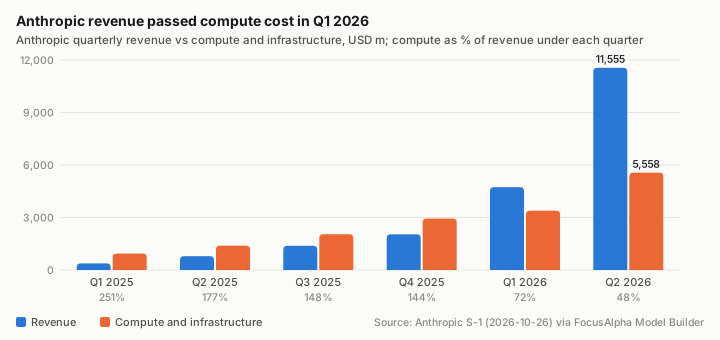
Figure 1: Anthropic revenue vs compute cost by quarter, Q1 2025–Q2 2026. Source: Anthropic S-1, via the FocusAlpha model.
| Anthropic quarterly results (USD m) | Q1 2025 | Q2 2025 | Q3 2025 | Q4 2025 | Q1 2026 | Q2 2026 |
|---|---|---|---|---|---|---|
| Revenue | 376 | 787 | 1,382 | 2,040 | 4,731 | 11,555 |
| Compute and infrastructure | 944 | 1,390 | 2,047 | 2,945 | 3,387 | 5,558 |
| Compute % of revenue | 251% | 177% | 148% | 144% | 72% | 48% |
| Operating income | (935) | (1,200) | (3,089) | (2,836) | (1,667) | 974 |
| Operating margin (GAAP) | −249% | −152% | −224% | −139% | −35% | 8% |
| Adjusted operating margin | −221% | −129% | −93% | −84% | −13% | 19% |
Source: Anthropic S-1 (Q3 2025 includes the $1.5bn Bartz settlement), via the FocusAlpha model.
Gross margin depends on what you count. Cost of revenue, which is mostly inference, was $2.38bn in the first half of 2026, an 85% gross margin, up from 40% for 2025. But research and development, where model training sits, was $9.74bn, or 60% of revenue. Sales and marketing was another $3.81bn, which includes fees paid to cloud partners. For the half year the GAAP operating loss was $693m. Adjusted operating income, which excludes $2.19bn of stock-based compensation and some other items, was $1.62bn.
The 85% inference margin is not the business margin. As long as frontier models keep improving, training is a recurring cost of staying competitive, not a one-off investment. The test for Anthropic each quarter is whether revenue grows faster than training and inference combined.
The headline 1H26 net loss of $80.7bn says little about the business: $72.4bn of it is a non-cash fair-value change on convertible notes.
How big are Anthropic's compute commitments, and with whom?
The commitments are the part of the S-1 that changes the picture. At the end of 2025, non-cancelable purchase commitments were $54.6bn. By June 30, 2026, fixed or minimum commitments were $265.6bn, and Anthropic has signed another $245bn since.
| Counterparty | Amount (USD bn) | As stated | Term | What binds it |
|---|---|---|---|---|
| Broadcom (TPU lease rent) | 161.2 | Approximately | Five years | Non-cancelable; excludes interest |
| SpaceXAI | 120.5 | Up to | Into 2029 | ~$3.1bn a month once delivered; cancelable on 90 days' notice after the initial period |
| Google Cloud | 114.5 | At least | Apr 2026 – Jul 2033 | Payable regardless of usage; shortfall paid as a true-up |
| Amazon (AWS) | 110 | At least | May 2026 – Apr 2036 | Payable regardless of usage; shortfall paid as a true-up |
| Microsoft (Azure) | 44.9 | At least | Nov 2026 – May 2033 | Payable regardless of usage; non-cancelable |
| Nscale | 44.6 | Up to | Into 2033 | Fees accrue as capacity is delivered |
| Lambda | 41.3 | Approximately | Into 2034 | Fees accrue as capacity is delivered |
| Additional TPUs, incl. Google (estimate) | 125–150 | Estimated range | 2028 – 2031 | Not in the commitments table |
| AMD (estimate) | 20+ | More than | — | Not in the commitments table |
| Fixed or minimum commitments, June 30, 2026 | 265.6 | Approximately | 1 to 20 years | |
| New and amended since June 30, 2026 | 245 | Approximately | Some subject to conditions |
Source: Anthropic S-1, FocusAlpha model, Commitments tab. Each amount links to the sentence in the filing that states it.
The Google, Amazon and Microsoft contracts are take-or-pay: Anthropic pays whether or not it uses the capacity. Only SpaceXAI can be cancelled on notice. Adding the named contracts and the TPU and AMD estimates gives close to $1trn of potential compute spending, nearly 20 times the end-2025 level.
Can Anthropic afford its compute bill? $200bn of 2028 revenue only just covers it
To compare commitments with revenue, we turned each contract into an annual cost by spreading it evenly over its term. This is our simplification; the actual payment schedules are not printed and will ramp with delivery. SpaceXAI uses its stated rate of $3.1bn a month.
| Anthropic annual compute cost by 2028, straight-line (USD bn) | Per year |
|---|---|
| SpaceXAI ($3.1bn a month) | 37.2 |
| Broadcom ($161.2bn over 5 years) | 32.2 |
| Google Cloud ($114.5bn over 7.3 years) | 15.6 |
| Amazon ($110bn over 10 years) | 11.0 |
| Microsoft ($44.9bn over 6.5 years) | 6.9 |
| Nscale ($44.6bn, ~7 years) | 6.4 |
| Lambda ($41.3bn, ~8 years) | 5.2 |
| Named contracts | ≈115 |
| Additional TPUs ($125–150bn over 2028–2031) | 31–38 |
| Including the TPU estimate | ≈146–152 |
Source: FocusAlpha calculation from the contract amounts and terms in the Anthropic S-1. AMD excluded (no schedule given).
Our model, which holds compute at Q2 2026's 48% of revenue, puts 2028E compute at $93.8bn. The named contracts alone cost about $115bn a year. That is a $21bn gap, so either revenue has to be higher or compute will take a larger share of it.
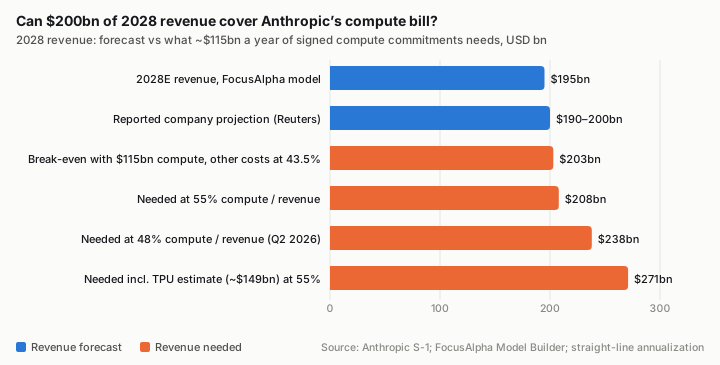
Figure 2: Anthropic 2028 revenue forecast vs the revenue needed to pay its compute commitments. Sources: Anthropic S-1; FocusAlpha model; Reuters via NST.
| Revenue Anthropic needs in 2028 (USD bn) | Revenue | Compute | Compute % | Operating margin |
|---|---|---|---|---|
| FocusAlpha model (compute held at 48%) | 195 | 93.8 | 48% | +8.4% |
| Model revenue, compute = named contracts | 195 | 115 | 59% | −2.2% |
| Break-even revenue with named contracts | 203 | 115 | 57% | 0% |
| Revenue for 55% compute ratio | 208 | 115 | 55% | +1.5% |
| Revenue for 48% compute ratio (Q2 2026 level) | 238 | 115 | 48% | +8.4% |
| Named contracts + TPU estimate, at 55% | 271 | 149 | 55% | +1.5% |
Source: FocusAlpha Anthropic model. Personnel, sales and partnerships, and other costs held at Q2 2026's combined 43.5% of revenue.
The result: if Anthropic reaches the reported $190–200bn of 2028 revenue and keeps its other costs at today's 43.5% of revenue, it roughly breaks even after paying for the compute it has already signed. It needs about $238bn to keep Q2 2026's 8% operating margin, and about $270bn if the additional TPU purchases go ahead. Anthropic has $131.7bn of cash and marketable securities (June 30, 2026) to cover the gap, and management says in the S-1 that new capacity may come online before the revenue it is meant to serve.
Compute commitments are fixed; revenue is a forecast. If demand comes in below plan, take-or-pay contracts give Anthropic a reason to cut token prices to fill idle capacity, which would press margins across the industry. Anthropic has moved its biggest risk from the income statement to the balance sheet: the model race decides who builds the best model, and the infrastructure contracts decide who keeps the profit.
You can change any assumption in the Anthropic model, such as the customer count, revenue per customer or compute ratio, and see the effect on 2028. For how Model Builder works and how its output checks out, see our audit of four AI-built three-statement models.
FAQ
What does Anthropic's S-1 show ahead of its IPO?
Anthropic's S-1, filed October 26, 2026, shows $16.3bn of revenue in the first half of 2026, 80% of it consumption-based, and a first positive GAAP operating quarter in Q2 2026 with an 8.4% margin (S-1). It also discloses $265.6bn of fixed compute commitments at June 30, 2026, plus about $245bn signed since. It held $131.7bn of cash and marketable securities at June 30, 2026.
What is Anthropic's revenue forecast for 2028?
Reuters reported in August 2026 that Anthropic projects 2028 revenue of roughly $190–200bn, citing people familiar with its financials (NST/Reuters). This is press reporting, not company guidance. FocusAlpha's driver-based model, built from the S-1, reaches $195bn for 2028E.
What could Anthropic be worth at its IPO?
Reuters reported that bankers are valuing Anthropic's IPO on its 2028 revenue forecast (NST/Reuters). Applying price-to-sales multiples to the $195bn of 2028E revenue in the FocusAlpha model gives about $1.56trn at 8x, $2.34trn at 12x and $2.93trn at 15x. These are model scenarios, not a price target, and they depend on revenue that is not yet earned.
How much has Anthropic committed to spend on compute?
As of June 30, 2026, Anthropic's S-1 lists about $265.6bn of fixed or minimum compute commitments, plus about $245bn of new and amended agreements signed after that date (S-1). It also estimates $125–150bn of additional TPU purchases and more than $20bn with AMD outside the commitments table. Together, potential commitments approach $1trn.
Who are Anthropic's largest compute providers?
By contract size in the S-1: Broadcom (about $161.2bn of TPU lease rent), SpaceXAI (up to $120.5bn), Google Cloud (at least $114.5bn), Amazon (at least $110bn), Microsoft (at least $44.9bn), Nscale (up to $44.6bn) and Lambda (about $41.3bn) (S-1). The Google, Amazon and Microsoft contracts are payable regardless of usage.
What is Anthropic's gross margin?
In the six months to June 30, 2026, cost of revenue was $2.38bn on $16.3bn of revenue, an 85% gross margin, up from about 40% in 2025 (S-1). That excludes model training, which sits in R&D ($9.74bn, 60% of revenue), so the gross margin overstates the economics of the business.
Is Anthropic profitable?
Anthropic reported its first positive GAAP operating income in Q2 2026: $974m on $11.6bn of revenue, an 8.4% margin, and a 19% adjusted operating margin (S-1). For the full first half it still had a $693m GAAP operating loss. The $80.7bn first-half net loss was mostly a non-cash fair-value change on convertible notes.
How much revenue does Anthropic need to support its compute commitments?
Spreading the named contracts evenly over their terms gives about $115bn a year of compute by 2028. With other costs at Q2 2026's 43.5% of revenue, Anthropic breaks even at about $203bn of revenue and needs about $238bn to keep an 8% operating margin (FocusAlpha model). Including the TPU estimate raises the requirement to about $270bn at a 55% compute ratio.
How do I build a financial model from an S-1?
FocusAlpha Model Builder builds a three-statement model from a company's SEC filings, with every reported figure linked to the place it is printed and forecasts driven by the KPIs the company discloses. The Anthropic model is an example built from the S-1 on its first day; filings data is available to agents through the SEC filings API.
What is FocusAlpha?
FocusAlpha is a SEC filings API and agent-ready financial data layer: it turns SEC filings (10-K, 10-Q, 8-K, 13F), earnings-call transcripts, and other trusted company communications into structured, normalized data where every value keeps its citation back to the source document. AI agents connect via API or MCP to research public companies from complete, trusted information.
Disclaimer
This article is analysis only and does not constitute investment advice or a recommendation to buy or sell any security. Forecasts are model estimates based on public filings and press reports and may be wrong.